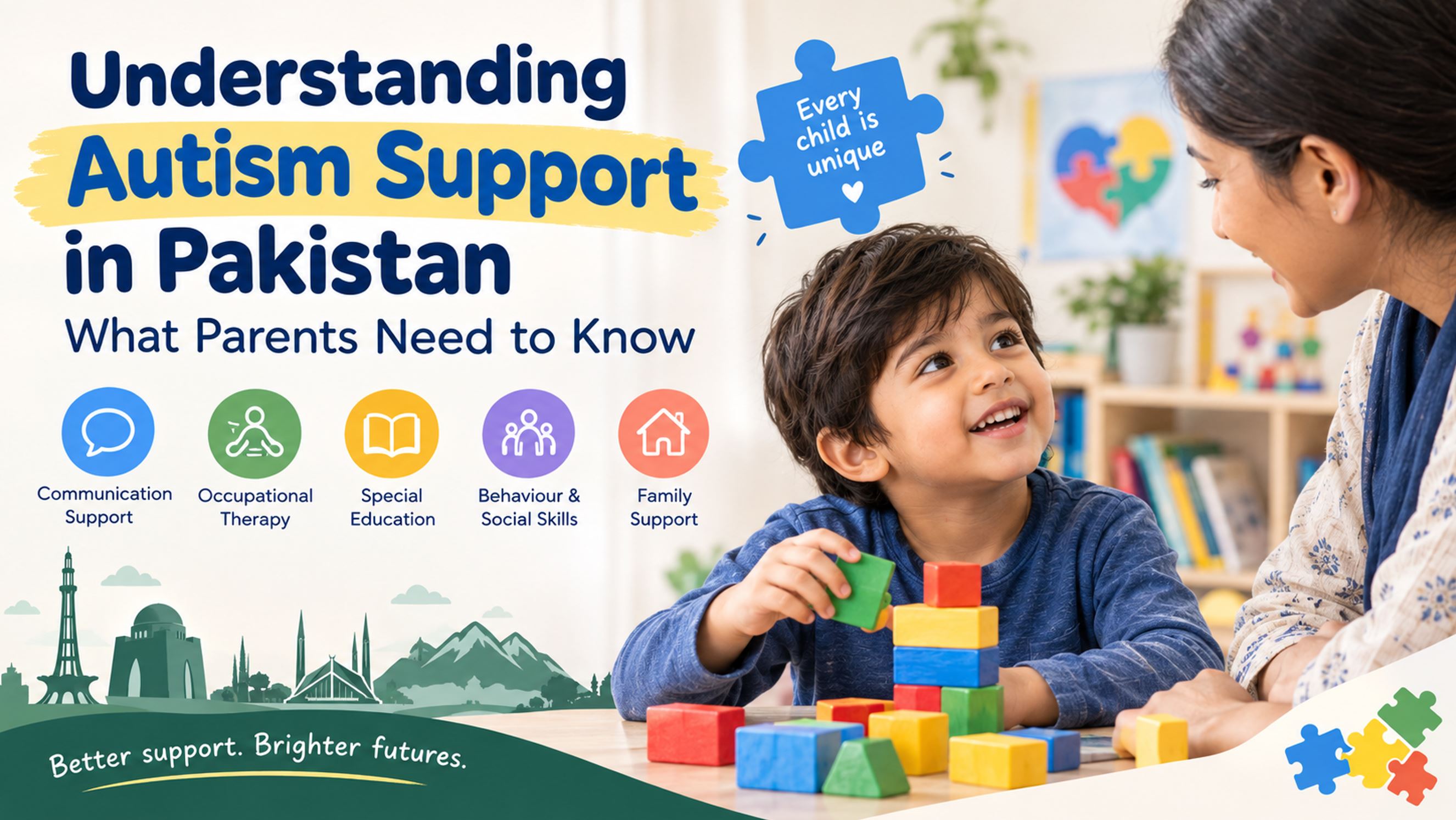
Understanding Autism Support in Pakistan: What Parents Need to Know
When parents first hear that their child may have autism, it can bring many questions and concerns. What does autism mean? What kind of support does my child need? Will my child be able to attend school? And perhaps one of the biggest questions is, where can I find the right autism support in Pakistan?
These concerns are understandable. Autism affects children in different ways. Some children may have significant communication difficulties, while others may speak well but struggle with social interaction, learning, behaviour, sensory experiences, or changes in routine.
This means there is no single approach that works for every child. The most helpful starting point is to understand the child's individual strengths and difficulties and then build support around those needs.
What Is Autism?
Autism, or autism spectrum disorder (ASD), is a developmental condition that can affect communication, social interaction, behaviour, learning, and the way a person experiences the world.
According to the World Health Organization (WHO), autism is a diverse group of conditions. The abilities and support needs of autistic people can vary significantly.
Some children may have difficulty communicating their needs. Others may struggle with social situations, changes in routine, sensory experiences, or understanding social cues.
It is important to remember that autism does not look exactly the same in every child.
What Signs May Parents Notice?
Parents are often the first people to notice that their child's development seems different.
Some children with autism may show differences in:
- Speech and language development
- Responding to their name
- Eye contact and social interaction
- Playing with other children
- Understanding social cues
- Expressing needs and emotions
- Repetitive movements or behaviours
- Adapting to changes in routine
- Sensitivity to sounds, textures, or other sensations
- Attention and learning
- Everyday independence
Noticing one of these signs does not automatically mean a child has autism. If parents have concerns, discussing them with an appropriately qualified professional is a better approach than trying to reach a diagnosis based on online information.
Parents can also read IBP International's early signs of autism in children to better understand some of the developmental differences they may notice.
Why Early Support Matters
Parents sometimes wonder whether they should start support or simply wait and see.
Seeking an assessment or therapy does not mean something is “wrong” with a child. It means parents want to understand their child's needs and provide appropriate opportunities to develop.
Depending on the child, support may focus on communication, social interaction, learning, behaviour, emotional regulation, sensory needs, daily living skills, or independence.
The WHO also highlights the value of evidence-based interventions that can support communication, social skills, wellbeing, and family needs.
Autism Support Is Not One Therapy
One common misunderstanding is that autism support means one particular type of therapy.
In reality, children may need help in several different areas.
For example, one child may need speech and language therapy because they have difficulty communicating. Another may need occupational therapy because sensory or motor difficulties are affecting everyday activities.
Some children may benefit from behaviour therapy, special education, or a combination of different approaches.
The important question is not simply, “Which autism therapy should we choose?”
A better question is:
“What does my child need help with?”
IBP International's Therapeutic Services include speech therapy, occupational therapy, behaviour therapy, sensory integration, play therapy, and counselling, allowing support to be considered according to the individual needs of the child.
Communication Support
Communication difficulties can look very different from one child to another.
Some children may have very limited speech. Others may speak but struggle with conversations, understanding questions, expressing themselves, or using language socially.
Support may focus on:
- Vocabulary and language development
- Expressing needs
- Understanding instructions
- Sentence formation
- Speech clarity
- Social communication
- Conversation skills
- Alternative communication methods when appropriate
The goal is not simply to make a child speak more. The goal is to help the child communicate effectively and confidently.
IBP International provides specialized support for children with autism and other developmental and learning needs through its educational and therapeutic programs.
Occupational Therapy and Sensory Needs
Some autistic children experience everyday sensations differently.
Sounds may feel too loud. Certain textures may be uncomfortable. Crowded environments may become overwhelming. A child may also have difficulty with fine motor skills, coordination, handwriting, dressing, or other daily activities.
Occupational therapy can help address areas such as:
- Fine and gross motor skills
- Sensory processing
- Coordination
- Attention
- Self-care
- Handwriting
- Daily living skills
- Independence
The right support depends on the child's individual needs. IBP's Therapeutic Services include occupational therapy and sensory integration as part of its wider support for children and families.
The Importance of Special Education
Autism support is not limited to therapy. Education is another important part of a child's development.
Some children can learn successfully in mainstream classrooms with appropriate support, while others may benefit from specialized educational programs.
Special education can support areas such as academic skills, communication, attention, classroom behaviour, social interaction, independent learning, and life skills.
The most important question is whether the educational environment allows the child to learn, participate, and develop confidence.
IBP's School for Slow Learners & Special Children supports children and youth with developmental and learning challenges, including children with Autism Spectrum Disorder, through academic, psychological, vocational, and therapeutic programs.
For students who need additional academic support, Trail Blazers Academy also provides individualized educational programs in a supportive environment.
Parents Are Part of the Support Team
Therapy does not stop when a child leaves a centre or classroom.
Parents can support development through everyday activities by:
- Keeping routines predictable
- Giving clear instructions
- Allowing enough time for the child to respond
- Encouraging communication
- Using the child's interests to encourage interaction
- Reading and playing together
- Practising strategies recommended by professionals
- Celebrating small improvements
Progress may not always look dramatic. For one child, progress may mean saying a new word. For another, it may mean asking for something independently, joining an activity, managing a transition, or becoming more independent.
These small steps matter.
Finding Autism Support in Pakistan
Finding the right autism support in Pakistan can sometimes feel confusing because there are different therapies, educational options, and opinions available.
Parents can start by asking:
- What are my child's strengths?
- What areas are causing the most difficulty?
- Does my child need communication support?
- Are sensory or motor difficulties affecting daily life?
- Would behavioural or educational support be helpful?
- What can we practise at home?
- How will progress be monitored?
The answers can help create a support plan based on the child's actual needs rather than simply trying different therapies without a clear direction.
Autism Support at IBP International
There is no single autism program that works exactly the same way for every child.
At IBP International, the focus is on understanding individual needs and providing specialized educational and therapeutic support for children with autism, learning disabilities, developmental difficulties, and other special educational needs.
Families can explore IBP's Therapeutic Services, School for Slow Learners & Special Children, and Remedial Services depending on the needs of their child.
If your child needs support with communication, learning, behaviour, sensory needs, or everyday independence, professional guidance can help you understand where to begin.
The goal should always be to help the child learn, communicate, participate, and become more independent while building on their individual strengths.
Frequently Asked Questions
Is autism the same for every child?
No. Autism is a spectrum, and children can have very different strengths, communication abilities, learning profiles, and support needs.
Does every child with autism need therapy?
Not necessarily. Support should be based on the child's individual needs, abilities, challenges, and developmental goals.
Can children with autism attend mainstream schools?
Some children can attend mainstream schools with appropriate support, while others may benefit from specialized education. The right choice depends on the individual child.
Where can parents find autism support in Pakistan?
IBP International provides specialized educational and therapeutic support for children with autism, learning difficulties, developmental needs, and other special educational requirements. Parents can contact IBP International to discuss their child's needs and explore appropriate support options.